RV Water Damage: Warning Signs, Causes, and What Repairs Cost
Soft floors, stained ceilings, and a musty smell are not minor annoyances — they are early warnings of a problem that compounds fast. Learn how to spot RV water damage before it becomes a structural crisis, and what restoration actually costs.
Water is the single most destructive force working against your RV — and it rarely announces itself. By the time you notice a soft spot in the floor or a brown ring on the ceiling, water has likely been moving through your walls, subfloor, and framing for weeks or months. For RV owners in Palmetto, Sarasota, Bradenton, and the broader Tampa Bay area, the combination of heavy seasonal rain, year-round humidity, and intense UV exposure makes this threat more serious than almost anywhere else in the country.
This guide covers what to look for, where water gets in, how damage spreads, and what you can expect to pay for repairs — so you can make an informed decision before a manageable problem becomes a total loss.
Early Warning Signs of RV Water Damage
The earlier you catch water intrusion, the less it costs to fix. These are the signs that should prompt an immediate inspection.
Soft or Spongy Floors
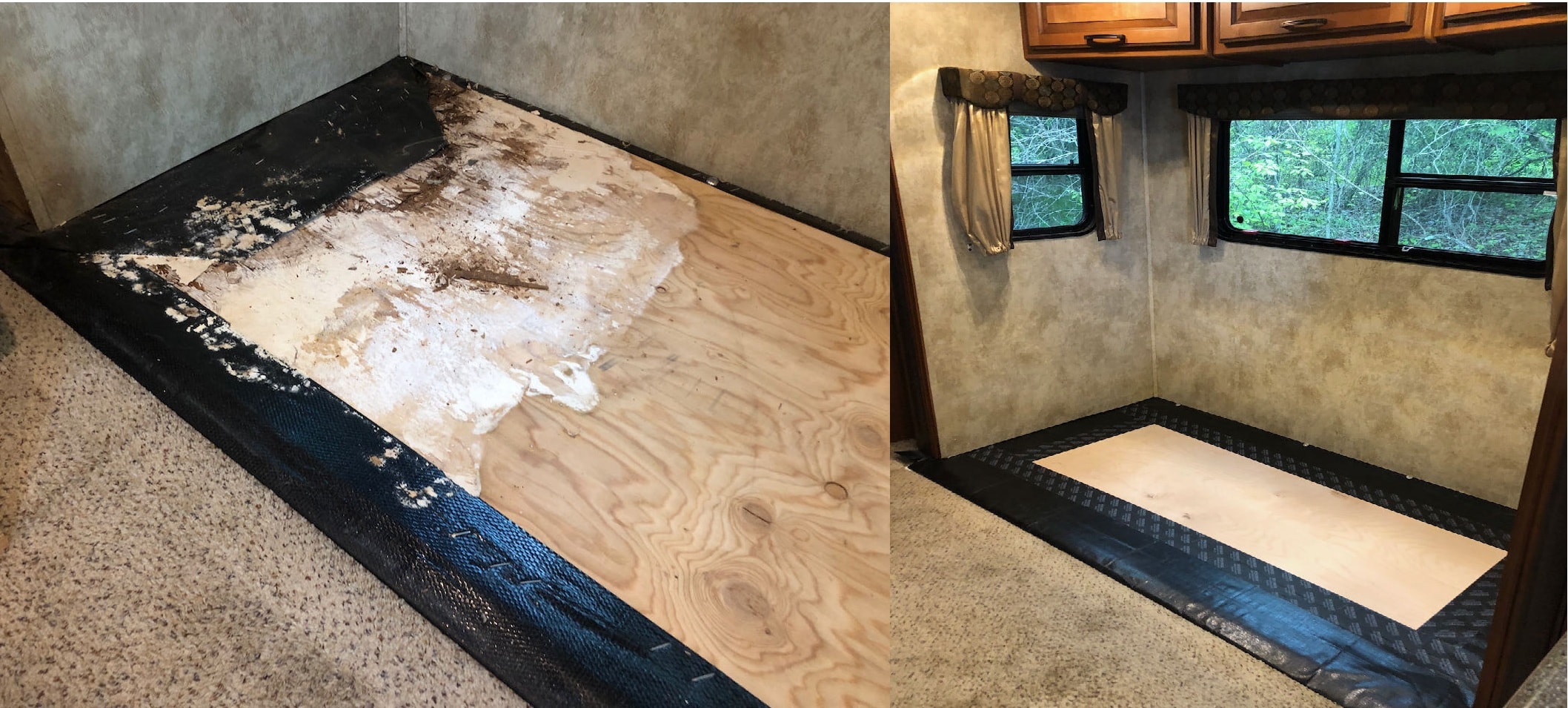
A soft floor in an RV is one of the most reliable indicators of water damage. When moisture saturates the subfloor — typically luan plywood or OSB — the material loses structural integrity and begins to compress underfoot. You may notice it first near the entry step, around the toilet base, or beneath the kitchen sink. Do not ignore it. A soft floor RV repair that is caught early may involve replacing a single panel; left alone, the rot spreads to the floor joists and chassis framing.
Ceiling Stains and Bubbling Wallboard
Yellow or brown staining on the ceiling or upper walls almost always traces back to a roof leak. Bubbling, warping, or delaminating interior wall panels are equally telling. The visible stain is rarely the full extent of the damage — water travels along framing members and insulation before it ever appears on a surface.
Musty or Mildew Odor
A persistent musty smell, especially in enclosed spaces like cabinets, closets, or the bedroom slide, points to mold or mildew growth. Mold can begin colonizing wet materials within 24 to 48 hours. In Florida's humidity, that window is even shorter. If your RV smells like a damp basement, treat it as a water damage issue until proven otherwise.
Delamination on Exterior Walls
RV delamination — the separation of the exterior fiberglass skin from the underlying foam and substrate — appears as bubbling, rippling, or cloudy sections on the sidewall. It is caused by water infiltrating the wall assembly and breaking down the adhesive bond. Delamination is expensive to repair and impossible to reverse without professional intervention. Catching it in a small area is far better than watching it spread across an entire panel.
Common Water Entry Points
Water does not need a large opening to cause serious damage. The most common entry points are:
Roof seams and lap sealant. The sealant along roof edges, around vents, skylights, and air conditioner bases degrades over time — especially under Florida's UV intensity. Cracks and gaps in lap sealant are the leading cause of RV roof leaks. Annual resealing is not optional; it is maintenance.
Slide-out seals. The rubber seals around slide rooms compress and wear with use. When they fail, rain and road water enter directly into the wall cavity surrounding the slide opening — one of the hardest areas to dry out and repair.
Windows and doors. The caulk and butyl tape sealing window frames and door surrounds can shrink, crack, or pull away from the substrate. Water that enters here runs down inside the wall and pools at the floor.
Vents and plumbing penetrations. Any point where a pipe, wire, or vent passes through the roof or an exterior wall is a potential entry point if the seal around it has not been maintained.
How Water Damage Spreads Silently
This is the part most RV owners underestimate. Water that enters through a pinhole crack in the roof sealant does not stay in one place. It wicks into insulation, travels along framing, and saturates subfloor materials — all while remaining invisible behind finished surfaces. By the time a soft spot or stain appears, the affected area is typically two to three times larger than what is visible. In Southwest Florida's climate, where temperatures and humidity accelerate mold growth and wood decay, the spread is faster than in drier regions.
The RV Water Damage Repair Process
A proper RV water damage restoration begins with a thorough moisture assessment — probing walls, floors, and ceilings with a moisture meter to map the full extent of intrusion before any demolition begins. Cutting into dry material wastes time and money; missing wet material guarantees the problem returns.
From there, the process typically involves removing damaged interior panels and flooring, drying the structural framing, treating any mold-affected surfaces, replacing rotted wood, and rebuilding the interior. If the roof is the source, RV roof services — including resealing, membrane repair, or full roof replacement — are completed before any interior work is closed up.
What RV Water Damage Repairs Cost
Cost ranges vary significantly based on how far the damage has spread:
- Minor leak with localized staining: $300 – $800 (sealant repair, surface treatment)
- Soft floor repair, single section: $800 – $2,500 (subfloor replacement, reseal entry point)
- Slide-out water damage: $1,500 – $4,500 depending on framing involvement
- Delamination repair: $2,000 – $6,000+ per panel
- Extensive structural damage: $5,000 – $15,000 or more, depending on RV size and scope
These figures assume the source of intrusion is identified and sealed as part of the repair. Fixing the interior without addressing the entry point is money wasted.
Why Florida RV Owners Face Higher Risk
Florida's rainy season runs from June through September, delivering intense, near-daily downpours across the Palmetto, Bradenton, Sarasota, and Tampa Bay region. That sustained moisture load stresses every seal on your RV. Add year-round humidity that prevents materials from fully drying between rain events, and UV radiation that degrades rubber and sealant faster than in northern climates, and the maintenance timeline compresses considerably. An RV that could go three years between roof inspections in the Midwest may need attention every twelve to eighteen months in Southwest Florida.
Do Not Wait on This
Water damage is one of the few RV repair categories where delay directly multiplies cost. A $400 sealant repair ignored for one season can become a $6,000 subfloor and wall restoration. If you have noticed any of the signs described above — soft floors, staining, delamination, or an unexplained musty smell — bring your RV in for an inspection before the next rain event.
The team at EliteRV in Palmetto is experienced in diagnosing and repairing water damage across all RV types, from Class A motorhomes to fifth wheels and travel trailers. An inspection takes less time than you think, and the information it gives you is worth far more than the alternative of finding out how bad it got.
Schedule your water damage inspection at EliteRV — serving Palmetto, Bradenton, Sarasota, and the greater Tampa Bay area.